

Artificial intelligence is beginning to move from simply supporting logistics teams to actively planning, deciding and acting across supply chains, according to DHL’s latest Logistics Trend Radar.
The eighth edition of the report identifies Agentic AI as one of the most significant emerging trends, alongside AI Commerce, the Compute Economy and humanoid robots.
DHL said the shift could make supply chains more autonomous and adaptive, while also changing the skills, responsibilities and working environments of logistics employees.
Katja Busch, Chief Commercial Officer at DHL and Head of DHL Customer Solutions & Innovation, said: “Supply chains are changing faster than ever as AI and workforce trends increasingly influence one another.”
She added that businesses able to understand those changes early would be better placed to turn them into practical advantages for both operations and employees.
Unlike earlier AI systems that mainly responded to prompts or analysed information, Agentic AI is designed to plan, make decisions and act towards defined goals with less human intervention.
DHL said this could allow systems to anticipate inventory shortages, reroute shipments around disruption and adjust transport capacity in real time.
AI Analytics is also expected to play a growing role by identifying patterns, forecasting outcomes and recommending actions at greater speed and scale.
Klaus Dohrmann, Vice President of Innovation and Trend Research at DHL Customer Solutions & Innovation, said: “Until now, AI has helped people perform tasks more efficiently. The next chapter is about action.”
He added: “We're entering an era of autonomous and physical AI, where intelligent systems can actively perceive the world, navigate complex environments, and make decisions with minimal human intervention.”
The report also highlights AI Commerce, which could reshape how consumers and businesses discover and buy products, while the Compute Economy reflects the growing strategic importance of computing infrastructure and data centre logistics.
Humanoid robots have also been added as a longer-term trend, with DHL suggesting they could eventually play a bigger role in physical automation within warehouses and other logistics environments.
Despite the growing use of AI and robotics, the report argues that logistics will continue to depend heavily on people.
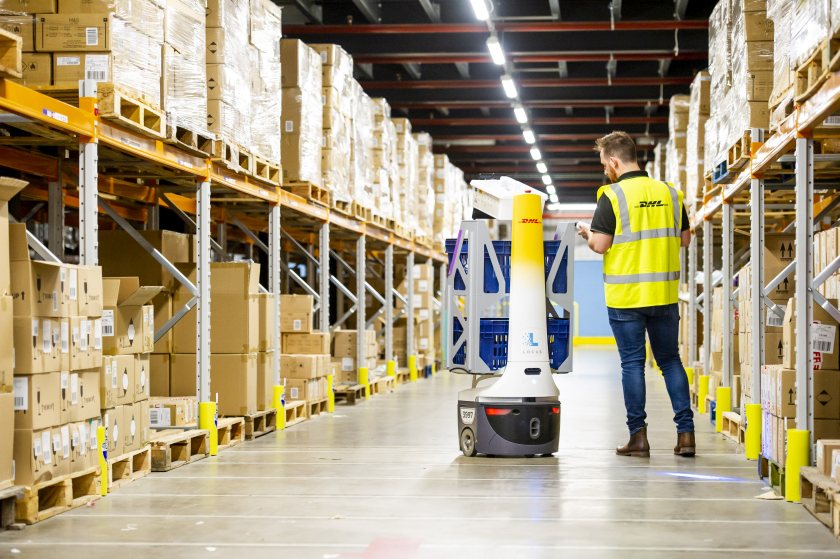
DHL said technologies including wearable sensors, remote operations, collaborative robots and AI-powered workplace assistants could improve safety, reduce repetitive work and help employees focus on higher-value tasks.
The report identifies Employee Belonging and the Augmented Workplace as key workforce trends as more employees begin working alongside AI assistants, digital systems and collaborative robots.
The changes are expected to affect a wide range of frontline, technical and knowledge-based roles, increasing demand for new skills and different ways of working.
Thomas Ogilvie, Chief Human Resources Officer and Labor Director at DHL Group, said: “Technology is transforming the way we work, but people remain the driving force behind every successful supply chain.”
He said AI assistants, wearable technology and collaborative robots were already helping employees work more safely and spend less time on repetitive tasks.
“The future of logistics will not be defined by human versus AI, but by how effectively organizations combine human expertise with increasingly capable technologies,” he added.
DHL said the growth of autonomous AI also increases the importance of governance, security and human oversight.
The report highlights AI Ethics and Cybersecurity 2.0 as important areas for businesses as intelligent systems become more deeply embedded in functions including demand forecasting, inventory planning and transport decisions.
Sustainability also remains a major theme in the latest Trend Radar.
DHL points to decarbonisation, sustainable fuels, circularity and the electrification of heavy and light vehicles as continuing drivers of logistics investment.
Businesses are increasingly deploying electric delivery fleets, expanding the use of alternative fuels and redesigning supply chains around reuse and greater resource efficiency, according to the report.
The Logistics Trend Radar is published every two years by DHL Customer Solutions & Innovation in collaboration with business, technology and academic specialists.
It tracks technological, business and social developments expected to influence logistics, supply chains and global trade over the coming decade.