

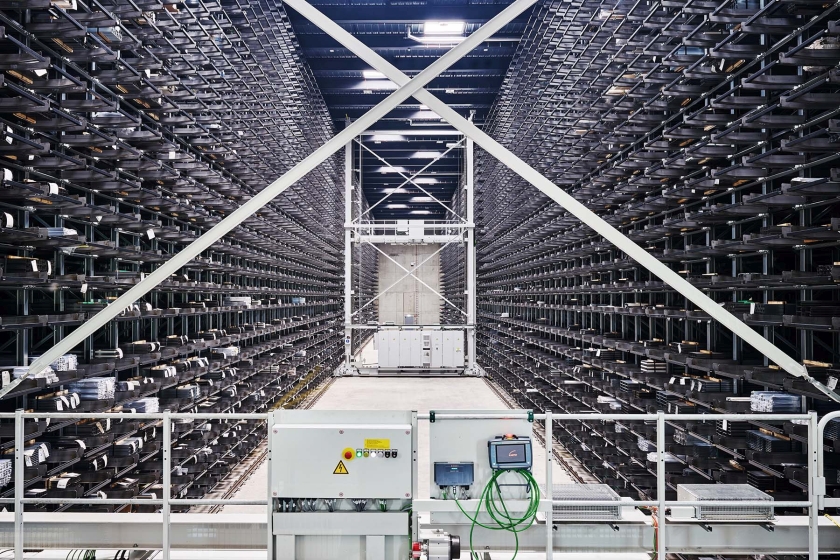
Materials are coming to workers rather than workers going to materials at Swiss manufacturer Forster Profilsysteme AG, following the installation of an automated high-bay storage system at its new production campus in Romanshorn.
The company has invested in a UNICOMPACT 2.5 honeycomb storage system from German manufacturer Kasto, transforming the movement of materials between goods receipt, production, order picking and dispatch.
Located on the southern shore of Lake Constance, the new Forster Campus was developed on a greenfield site following the company's relocation from nearby Arbon.
Forster manufactures steel and stainless-steel profile systems used by specialist fabricators to produce doors, windows and facades, including products offering fire and smoke protection, burglary resistance and bullet resistance.
Rather than relying on employees to collect materials from storage areas, the new facility uses automation to deliver the required profiles directly to production workstations.
Measuring 98 metres long and 22 metres wide, the UNICOMPACT system accommodates 5,165 storage cassettes containing raw materials, semi-finished products and completed profile bundles.
Two automated gantry cranes retrieve and deposit the cassettes, allowing the centrally positioned warehouse to serve both manufacturing and dispatch operations.
By arranging production and logistics areas around the storage system, Forster has reduced unnecessary internal transport movements while improving access to materials.
Fabian Strim, production manager at Forster, said: “The layout of the factory, the positioning of the storage system and all input/output stations are perfectly coordinated with our material flows. We now have the optimal solution.”
The automated process begins when a production workstation requires material. Forster's enterprise resource planning (ERP) system sends a request to the UNICOMPACT, prompting one of the gantry cranes to retrieve the appropriate cassette.
The cassette is then transferred to the relevant input/output station, each of which has two positions to enable rapid exchanges.
While one position receives an empty or partially filled cassette returning from production, the other can deliver fresh material to a machine in approximately 25 seconds.
Operators can then remove the individual lengths required for processing without having to leave their workstations to collect stock.
The system also supports order picking and dispatch, eliminating the need for separate storage areas for finished products.
Completed profile bundles are requested through the ERP system and transported automatically to one of two loading points on the opposite side of the factory.
A gantry crane supplies the requested cassettes at approximately one-minute intervals, after which an indoor crane transfers the finished bundles into waiting lorries.
The integrated arrangement provides a central materials hub, replacing the extensive internal transport routes associated with decentralised storage.
Improving workplace safety and ergonomics was another important consideration in the development of the campus.
At Forster's previous facility, materials were held in a large horizontal storage area, requiring employees to walk considerable distances to locate and retrieve goods.
The automated approach reduces manual handling of heavy loads and limits the need for employees to move beneath overhead lifting equipment.
Strim explained: “Initially, for some employees it was a big adjustment to no longer access goods directly. However, their trust in the automation grew and now the feedback from our operators is overwhelmingly positive. When goods are delivered directly to them, their work becomes much more convenient.”
Integrating the high-bay warehouse into the building also presented an engineering challenge, as the storage system stands 15 metres tall while the factory itself has a height of 14 metres.
The solution was to install the warehouse within an excavated pit, avoiding the need to increase the building's roof height.
This preserved the uniform roof design required for solar panels while providing a concrete enclosure that stabilises the installation without the need for foundation piling.
Alongside the UNICOMPACT, Forster operates a smaller automated Kasto UNITOP 1.5 overhead storage and retrieval system, which was transferred from its former Arbon premises.
Used for storing partially filled pallets and supplying individual profiles, the UNITOP has supported customer call-off orders since 2014.
The relocated system provides 716 storage spaces, each capable of accommodating two cassette formats.
Moving the installation required extensive planning, as its existing cassettes and stored materials had to be temporarily accommodated during the relocation.
Forster's previous experience with the UNITOP played an important role in its decision to select Kasto for the larger automated warehouse.
Strim said: “The UNITOP storage system is reliable, low-maintenance and straightforward. It delivers exactly what KASTO promised us, which is why we chose the same supplier for our honeycomb high-bay warehouse.”
Despite the complexity of the project, the new UNICOMPACT system became operational on schedule in February 2024.
“The time pressure to complete the project was immense, but thanks to detailed planning and ongoing communication with the experts at KASTO, the process went smoothly. Our experience has been entirely positive,” Strim added.
The investment has enabled Forster to consolidate its inventory within a central automated storage facility, shortening material transport routes and reducing manual intervention throughout production and dispatch.
It also demonstrates how automated storage technology can influence the design of an entire manufacturing facility, rather than simply serving as a standalone logistics operation.