

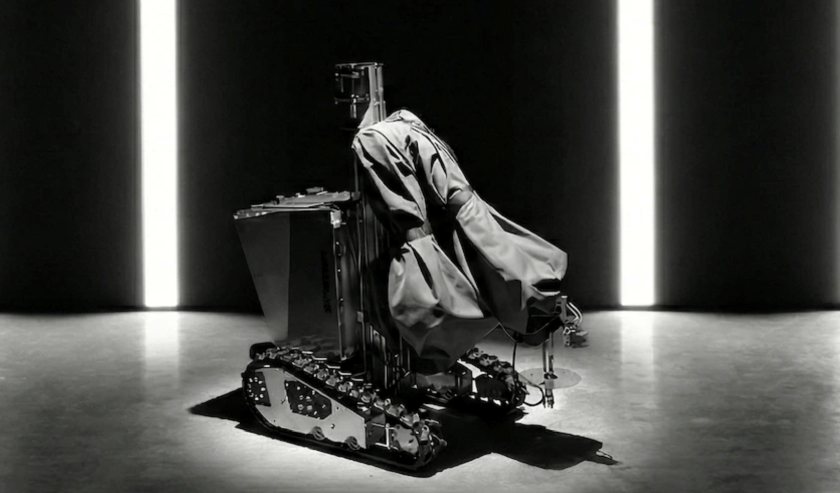
A Munich robotics start-up has secured €4 million in pre-seed funding to bring AI-powered construction robots onto building sites and tackle Europe’s mounting infrastructure repair backlog.
Sitegeist, a spin-out from the Technical University of Munich (TUM), is developing automated, modular robots designed to carry out concrete renovation work — one of the most labour-intensive and capacity-constrained tasks in construction.
The funding round was co-led by b2venture and OpenOcean, with participation from UnternehmerTUM Funding for Innovators and several angel investors, including Verena Pausder, Lea-Sophie Cramer and Alexander Schwörer, alongside strategic backers from the construction and robotics sectors.
The company said the capital will be used to expand its team and accelerate deployment of its AI-enabled robots on live construction sites, as demand grows amid Europe’s infrastructure repair crisis.
Across the continent, ageing bridges, tunnels, car parks and public buildings require urgent renovation. In Germany alone, the infrastructure repair backlog runs into the hundreds of billions of euros, according to KfW, with similar pressures seen in North America.
At the same time, a shortage of skilled labour continues to slow progress, particularly in physically demanding areas such as concrete repair.
Unlike traditional automation systems that depend on pre-existing 3D models or standardised site conditions, Sitegeist’s robots are designed to operate directly on existing structures.
Using advanced perception systems, AI-based decision support and adaptive control, the machines can handle complex geometries and varying material conditions without prior digitisation, enabling use on real-world renovation projects.
“Infrastructure renovation is hitting a critical bottleneck, especially in concrete repair,” said Dr Lena-Marie Pätzmann, co-founder and chief executive of Sitegeist.
“Today, deteriorated concrete is still removed using manually-intensive processes that are hard to scale. We're tackling this challenge with the first ever specialized automated and modular robots that can perform concrete renovation directly on existing structures.”
She added that the backing from investors would help accelerate the rollout of automated renovation technology to critical infrastructure worldwide.
Concrete renovation remains one of the most complex areas of infrastructure maintenance. Damaged concrete must be removed precisely, often using high-pressure water or abrasive blasting, without harming steel reinforcement beneath.
The work is typically manual and highly site-specific, requiring constant supervision and specialist experience.
Driven by labour shortages, safety requirements and low productivity, many contractors are fully booked months or even years in advance, contributing to significant project delays.
Sitegeist said its modular robotic platform is designed specifically for unstructured construction environments, increasing throughput and quality while reducing rework.
The company is working directly with concrete renovation contractors and plans to collaborate with additional test sites and co-development partners to further refine its technology.
Florian Schweitzer, partner at b2venture, described the current approach to concrete removal as “devastating and extremely arduous”.
“This is the perfect case for augmenting humans with robots,” he said.
Sam Hields, partner at OpenOcean, said non-humanoid machines were emerging as some of the most promising AI applications.
“The most exciting AI-powered robots today don’t have fingers and thumbs,” he said.
He added that the company’s technology is aimed at automating “a manual, expensive process with low talent availability” at a time when ageing populations and skills shortages are placing additional strain on physical industries.
Sitegeist was founded by Dr Pätzmann, alongside Claus Carste, Julian Hoffmann and Nicola Kolb, who met at TUM and through the Munich start-up ecosystem. The company originated from a robotics research institute led by Professor Matthias Althoff.