

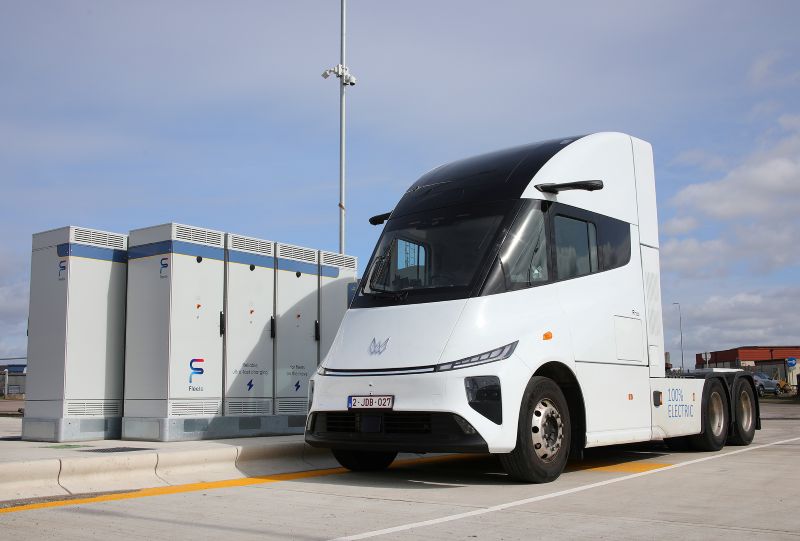
A new generation long range electric heavy goods vehicle has made its UK debut after completing its first charge at the Fleete ultra rapid truck charging hub at the Port of Tilbury.
The Windrose Global E700 6x4 electric tractor unit arrived in the UK this week and headed directly to Fleete’s newly opened 5MW charging facility, where the truck successfully completed its first charge on British soil. The visit marks the start of a nationwide demonstration tour aimed at showcasing how long range electric HGVs could operate on UK freight routes using high power charging infrastructure.
Developed by Belgium based OEM Windrose Technology, a company with strong Chinese engineering roots, the Global E700 has been designed from the ground up as a long distance electric freight vehicle capable of competing with conventional diesel trucks on demanding logistics routes.
The truck features a distinctive centre driver cab layout, which Windrose says improves visibility, safety and driver ergonomics. While centre seating has historically been associated with specialist vehicles such as McLaren road cars and some military platforms, its introduction in a heavy goods vehicle highlights the company’s attempt to rethink traditional truck design as the industry moves towards electrification.
At the heart of the Global E700 is a battery system exceeding 700kWh, using a flexible four pack configuration designed to support heavy freight duty cycles. According to Windrose, the truck can deliver a range of more than 700km even when fully loaded and operating at motorway speeds, placing it among the longest range electric HGV platforms currently under development.
The vehicle is equipped with both Megawatt Charging System and CCS2 charging capability as standard, allowing it to connect to existing high power infrastructure while also supporting the next generation megawatt scale charging technology that is currently being rolled out across Europe.
The UK charging demonstration took place at Fleete’s newly commissioned high capacity hub at Tilbury, which has been specifically designed to support electric heavy vehicles operating in the logistics sector.
The 5MW site can charge up to 16 electric trucks simultaneously and includes six Siemens Flex 540kW chargers and twelve Flex 500A dispensers distributed across three charging islands. Each island has been designed to support future upgrades to Megawatt Charging System capability as higher power vehicles enter the market.
In addition to the Siemens equipment, the site also includes four charging points supplied by Power Electronics, using NB cooled dispensers and an NB Station system capable of delivering up to 270kW per charging point with upgrade potential to 360kW.
Chris Morrison, CEO at Fleete, said the arrival of the Windrose truck demonstrated the type of infrastructure that will be required if electric heavy goods vehicles are to scale across the UK freight sector.
“Hosting the first UK charge for the Windrose truck is a strong demonstration of what high power infrastructure for heavy vehicles can deliver,” Morrison said.
“Vehicles with battery capacity of this scale need high power infrastructure that can deliver energy quickly and reliably. Shared charging hubs like Fleete Tilbury are designed to provide exactly that as more fleets begin deploying electric trucks on longer routes.”
High capacity public charging infrastructure is increasingly seen as a critical missing piece in the electrification of heavy transport. While electric vans and smaller vehicles have benefitted from a rapidly expanding public charging network, the infrastructure required to support 40 tonne articulated trucks is far more demanding.
Electric HGVs require significantly higher charging power, larger grid connections and greater space for manoeuvring large vehicles. These factors have made depot based charging the dominant model for early deployments, but this approach can limit flexibility for fleets operating national distribution routes.
Shared charging hubs such as the Tilbury site aim to address this challenge by providing open access facilities located close to major freight corridors, ports and logistics clusters.
The Port of Tilbury itself represents one of the busiest logistics gateways in the UK, handling a wide range of cargo including containers, construction materials, food products and automotive freight. Its location on the Thames with direct access to the national motorway network makes it an important testbed for emerging zero emission freight technologies.
Justin Yu, Head of Northern Europe at Windrose Technology, said the company deliberately selected the Tilbury hub as the starting point for the truck’s UK demonstration programme.
“Completing our first charge in the UK at Fleete’s Port of Tilbury hub is an important milestone for Windrose and a fitting place to begin the truck’s UK tour,” Yu said.
“Our aim is to demonstrate how the next generation of electric heavy trucks can work with high power charging infrastructure across the UK, and the ultra rapid capability here at Tilbury is exactly the kind of quality charging network operators will need.”
Yu added that strategically located charging hubs capable of delivering megawatt scale power will play an important role in enabling logistics operators to transition away from diesel powered trucks.
The Global E700 will now embark on a series of visits to logistics depots, transport operators and truck charging facilities across the country as part of a broader effort to showcase how long range electric trucks could operate within existing UK freight networks.
Electric HGV development has accelerated rapidly in recent years as truck manufacturers respond to tightening emissions regulations and growing pressure from major retailers and logistics providers to decarbonise freight operations.
Several manufacturers including Volvo Trucks, Mercedes Benz Trucks, Scania and MAN have already launched battery electric heavy trucks for regional distribution routes. However, long distance haulage remains one of the most challenging sectors to electrify due to the energy requirements associated with moving heavy loads over hundreds of kilometres.
Battery capacity, vehicle weight and charging infrastructure all play a role in determining the viability of electric long haul trucks. Vehicles such as the Windrose Global E700, which combine large battery packs with ultra rapid charging capability, represent one of the approaches currently being explored by manufacturers to overcome these limitations.
Fleete, founded in 2022 by Macquarie Asset Management’s Green Investments team, is positioning itself as a key provider of shared charging infrastructure for commercial fleets. The company focuses on developing scalable charging hubs designed specifically for heavy duty vehicles, with the aim of simplifying the transition to zero emission logistics.
Rather than requiring fleets to invest in their own high capacity grid connections and charging equipment, Fleete’s shared user model allows operators to access charging infrastructure on demand. This approach can help address some of the major barriers to fleet electrification including land availability, grid constraints and the high capital cost of installing depot charging systems.
As electric truck technology continues to develop, infrastructure availability is likely to play a decisive role in determining how quickly the UK freight sector can transition away from diesel powered vehicles. Demonstrations such as the Windrose charging event at Tilbury highlight how vehicle technology and charging networks will need to evolve together if long distance electric freight is to become commercially viable.
For logistics operators evaluating future fleet investments, developments in battery capacity, megawatt charging systems and shared charging hubs will increasingly shape decisions around how and when electric trucks can be integrated into existing transport operations.