

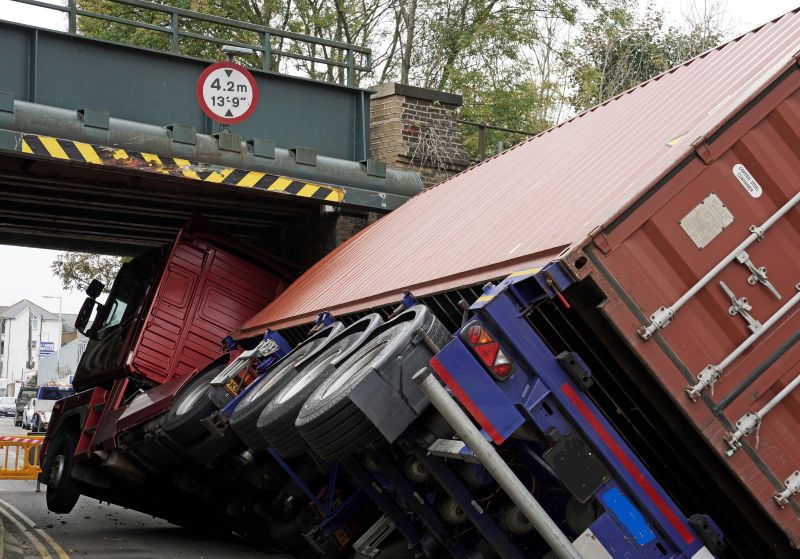
Fleet operators are being urged to strengthen their approach to low bridge safety as bridge strikes continue to present a costly and disruptive issue across the UK road network.
Latest data from Network Rail underlines the scale of the problem. Between 1 April 2024 and 31 March 2025, 1,666 bridge strikes were recorded—equating to roughly one incident every five hours. These collisions led to more than 120 days of cumulative rail delays, totalling over 186,000 minutes, and resulted in an estimated £23 million cost to the taxpayer.
While the financial impact is significant, the operational consequences for fleets are equally serious. Bridge strikes can lead to vehicle damage, load loss, insurance claims, delivery delays and reputational harm, alongside the wider disruption caused to both road users and rail services. In some locations, the same bridges are struck multiple times each year, highlighting persistent gaps in route planning and driver awareness.
High sided vehicles remain the most common contributors to these incidents, particularly where variable load heights are involved or where drivers are unfamiliar with routes. Industry guidance continues to emphasise that many bridge strikes are preventable through accurate journey planning, correct vehicle height recording and better use of mapping tools designed for commercial vehicles.
However, with increasing time pressures across logistics operations and a growing reliance on agency drivers or unfamiliar routes, additional in cab support is becoming more relevant. In response, Durite has introduced an AI Low Bridge Detection System designed to provide real time alerts to drivers approaching restricted height structures.
The system combines forward facing camera technology with artificial intelligence and a high accuracy 10 Hz GPS feed linked to a UK low bridge database. This enables it to identify potential hazards in advance and warn drivers before they reach a bridge with insufficient clearance.
John Nobbs, Sales Director at Durite, said the industry needs to view technology as part of a wider safety framework rather than a standalone solution. He noted that the true cost of bridge strikes extends beyond infrastructure damage to include safety risks, operational disruption and long term business impact.
The system has been taken on by Sentinel Systems as part of its vehicle safety offering, with a focus on integration into existing fleet technology. According to Sentinel’s Managing Director John Little, compatibility with MDVR systems and the ability to input vehicle height are key advantages, particularly for fleets operating with variable loads.
The system compares programmed vehicle height against upcoming bridge clearances and provides a clear in cab warning, giving drivers additional time to react and reroute if necessary. Ease of installation and usability are also cited as important factors for fleet adoption.
Despite advances in detection technology, industry bodies continue to stress that route planning remains the most effective defence against bridge strikes. Ensuring drivers are equipped with accurate vehicle height information, using truck specific navigation systems and reinforcing training around restricted routes are all considered essential measures.
Durite maintains that AI based systems should be viewed as an added layer of protection, supporting drivers in real world conditions where missed signage, distractions or route changes can occur. Integration with wider camera and telematics systems also allows fleets to build a more complete safety ecosystem across mixed vehicle operations.
With bridge strikes showing little sign of decline and repeated incidents at known hotspots, attention is increasingly turning to how fleets combine planning, training and technology to reduce risk and maintain operational continuity.