

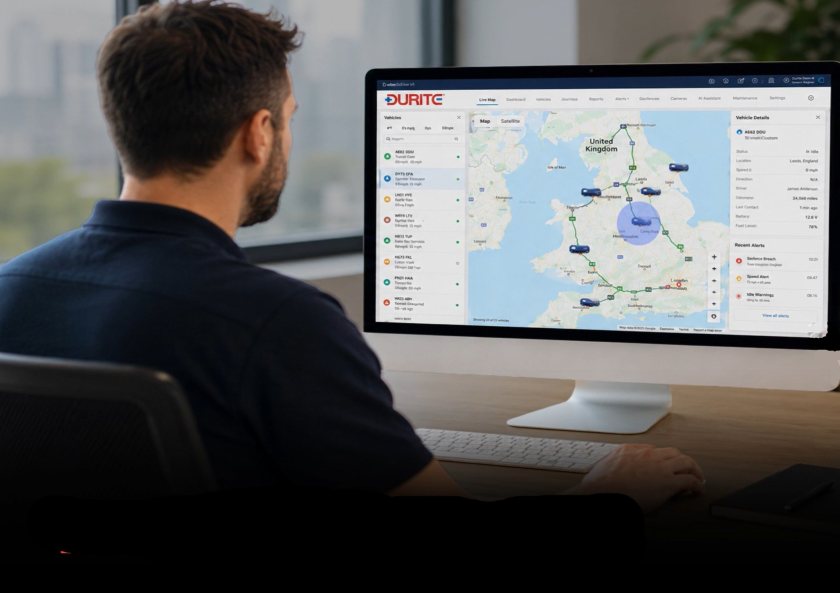
Artificial intelligence could help commercial vehicle operators spot dangerous driving and prevent accidents before they happen, as new connected technology promises to transform fleet road safety.
Vehicle safety specialist Durite has launched an AI-powered fleet management platform designed to identify risks in real time, monitor driver behaviour and improve safety across commercial fleets.
The system, called Durite Live AI, combines live vehicle tracking, AI-enabled cameras, driver behaviour analysis and predictive insights within a single platform.
According to the company, the technology represents a shift away from traditional fleet safety management, which often relies on investigating incidents after they have occurred.
Instead, AI can analyse driving patterns and operational data to identify potentially unsafe behaviour, allowing fleet managers to intervene before risks escalate.
Vidwan Algoo, Fleet Technology Manager at Durite, said connected systems were becoming increasingly important as operators look to improve road safety.
“Connected safety technologies are becoming an increasingly important part of modern fleet management,” he said.
“AI-enabled systems can provide operators with valuable real-time insight into driver behaviour, road conditions and operational risks, allowing earlier intervention and improved decision-making across the fleet.”
The platform uses artificial intelligence to assess driver behaviour and journey information, automatically identifying potential hazards and prioritising alerts.
It also offers tailored driver coaching, helping operators address unsafe driving habits without having to manually review large amounts of routine footage and data.
Among its features are AI risk detection, driver monitoring, trip-based coaching and First Notice of Loss reporting, which helps businesses record and manage incidents.
An integrated AI assistant is also available around the clock to support fleet management activities.
The technology could be relevant to businesses operating commercial vehicles across a range of sectors, including agricultural enterprises with transport and delivery operations.
However, the growing use of cameras and driver monitoring systems also raises questions about privacy and the handling of personal information.
Durite said its platform includes automatic face pixelation and mosaic blurring to obscure individuals where appropriate, helping businesses manage recorded footage in line with their privacy policies.
The company says these features are intended to support compliance with UK data protection requirements while preserving footage that may be needed as evidence following an incident.
Durite Live AI can also be integrated into a wider vehicle safety system, alongside technology such as wireless AI cameras, driver monitoring equipment and low bridge detection systems.
The latter could be particularly relevant to operators of larger commercial vehicles travelling on rural roads and unfamiliar routes.
Durite said the platform had attracted interest from businesses in haulage, logistics, utilities, vehicle recovery, construction and municipal services following its launch at the Road Transport Expo.
Mr Algoo said operators were approaching the technology from different starting points, with some exploring AI safety systems for the first time.
“We met organisations at every stage of their fleet technology journey, from operators looking to introduce AI for the first time to those seeking a more integrated approach to fleet safety and operational management,” he said.
“The level of engagement reinforces the growing recognition that connected technologies can deliver significant benefits across compliance, driver welfare, operational efficiency and risk management.”
The company believes connected safety systems will play an increasingly important role in commercial transport, combining conventional vehicle safety equipment with intelligent monitoring and predictive technology.
It argues that giving operators earlier warnings about developing risks could help improve driver welfare, reduce incidents and support more efficient fleet management.
However, the effectiveness of such systems will depend on how operators use the information, respond to warnings and balance safety monitoring with driver privacy.