

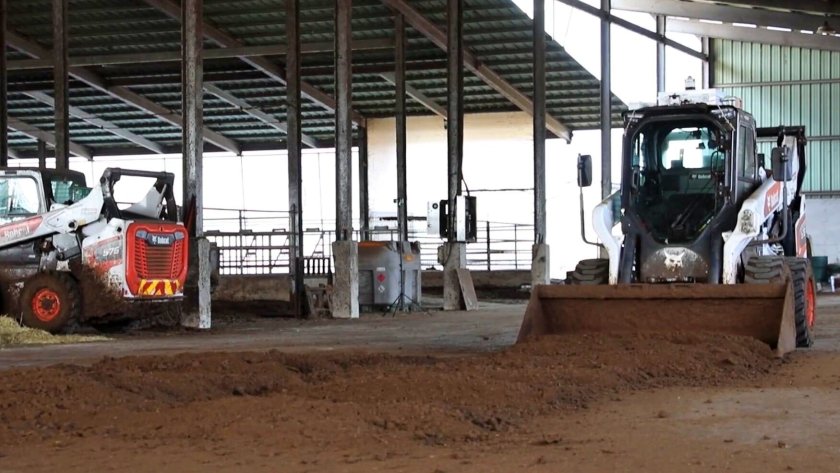
Bobcat has demonstrated a driverless loader capable of clearing manure from livestock barns using artificial intelligence, as the machinery manufacturer explores ways to tackle agricultural labour shortages.
The company has successfully trialled an autonomous version of its S76 skid-steer loader in collaboration with South Korean artificial intelligence specialist MAUM.AI.
During the demonstration, the machine independently collected, transported and unloaded manure without operator intervention.
The technology uses Vision-Language-Action (VLA) artificial intelligence, combining cameras and other sensors to assess its surroundings, make decisions and control the machine’s movements.
Unlike conventional automated machinery, which follows predetermined instructions, the system can adapt its movements according to its working environment.
Bobcat selected manure handling as its first demonstration task in response to persistent labour shortages facing livestock farms, partly driven by rural depopulation.
The two companies progressed from initial technology testing to a successful demonstration in a working livestock barn within five months of signing a collaboration agreement in June.
During the first demonstration, the loader repeatedly scooped manure into its bucket before transporting and unloading it into a trailer approximately 2.4 metres high.
A second trial saw the machine identify manure spread across the barn floor and independently determine a cleaning route.
Keeping its bucket close to the ground, the loader collected the manure before depositing it at a designated location.
Both tasks were completed without operator intervention.
Charlie Park, executive vice president and chief strategy officer at Doosan Bobcat, said the demonstration marked the first significant outcome of the partnership.
He said: “We will expand collaboration among our global R&D teams and with diverse partners to advance autonomous operation and unmanned technologies, and develop them into practical solutions that improve customers' productivity and work efficiency.”
Chris Choi, chief technology officer at MAUM.AI, said the successful trial demonstrated how artificial intelligence could address physically demanding tasks across different industries.
He said: “The successful demonstration of autonomous manure handling—a labour-intensive task that workers often avoid—shows Physical AI’s potential to solve real-world challenges across industrial worksites.”
Bobcat now plans to explore further applications for autonomous machinery, targeting repetitive, physically demanding and difficult jobs across farming, landscaping and construction.
The development also marks a return to the machinery manufacturer's agricultural roots.
More than 65 years ago, brothers Louis and Cyril Keller developed a compact, manoeuvrable loader to address the challenges of cleaning turkey barns in Minnesota.
Their invention laid the foundations for the Bobcat brand and the development of an entirely new machinery sector.
While the latest demonstration highlights the potential for autonomous technology on livestock farms, Bobcat has not disclosed a timeline for commercial availability.