

Manufacturing relies on a series of machines and tools to produce a diverse range of products. Each machine performs a specific function ensuring components are precision engineered to the highest standards. Manufacturing companies benefit from today's sophisticated machinery providing fast, effective results and uniformity across large batches. The same tools might also be used for specialised procedures for particular projects. Many of the latest manufacturing machines have often evolved from their early nineteenth-century predecessors to include innovative technology and computerisation.
Vertical and horizontal millers operate by means of a rotating blade. It cuts slivers of metal from a piece of work until the required shape is achieved. The milling machine is suitable for cutting flat, pre-formed and three-dimensional structural metal. The cutting device of a milling machine may rotate, or it may be fixed while the table rotates the work instead. The advantages of milling machinery include high productivity and speed. It's also a versatile machine that can be used for cutting slots, gears and threads on all types of metal including aluminium, steel, nickel and brass.
The lathe is one of the oldest forms of machinery which is suitable for use with metal and wood. A workpiece is held by a chuck at each end to form a spindle or axle, then rotated at variable speeds. A cutter then moves into the material to grind away excess to cut grooves or achieve a particular shape. Cutting tools are generally flat, but they can be customised to any design. The cutter is usually fixed to a moveable carriage lying parallel to the workpiece and can be moved accordingly depending on the product's requirements. Lathes can be constructed in any size, making them suitable for a vast range of industries, including watch making, tooling and car production.
The turning machine has directly evolved from the lathe- it performs a similar operation, but at a more complex level. It often includes sophisticated Computer Numerical Control (CNC), providing pre-programmable computerisation for greater efficiency and accuracy. It may also offer multiple axis capacity and may include additional features such as milling and drilling, leading to increased rates of productivity.
These widely used manufacturing machines primarily drill holes into a piece of work. The spindles of the borers are available in a wide range of sizes, making them suitable for all types of applications. Vertical borers operate vertically with a fixed tool drilling into a moveable workpiece. Horizontal borers are the opposite, boring holes into a stationary object through a moveable tool. CNC capability increases their power and versatility.
There are many types of drilling machine that generally operate at speeds of up to 3,600 RPM. A bench drill is a compact machine that's fixed to a work surface and usually drills lightweight metals. A pillar or upright drill is larger and suitable for a greater range of materials. The drill bit usually moves into a fixed workpiece, and heavy industry companies often make use of the radial drill. This versatile machine has the drill bit attached to a sliding carriage on a rotational arm providing enormous manoeuvrability. Drills with multiple spindles simultaneously drill numerous holes into a workpiece, helping to significantly increase productivity. Deep hole drills are capable of drilling extensive holes to create long tubes and barrels.
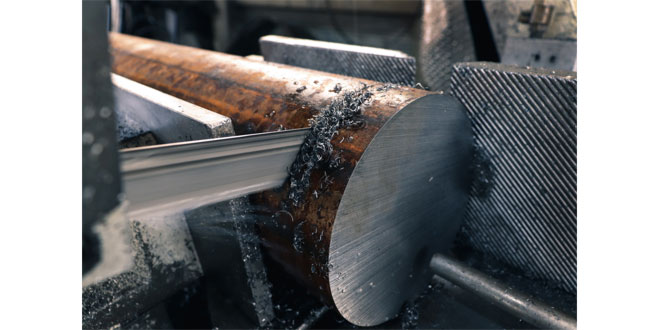
One of the most popular manufacturing machines is the bandsaw. It's highly versatile for cutting wood and metal, making it an indispensable tool across many industries. Metal cutting bandsaws are used to cut and shape pieces of work. They operate through a fixed, long blade that continually rotates around two large wheels, leaving the workpiece free for increased manoeuvrability. Bandsaw blades offer a choice of effective cutting edges including bi-metal, cobalt edge and carbide grit, enabling a variety of metals to be sawn from aluminium to titanium. Bandsaws can be manual, semi-automatic or fully automatic. CNC band saws include the latest technology, providing automation and computerisation for high levels of fast, unsupervised productivity.
A grinder is used to quickly wear down and sand the surfaces of a workpiece, leaving a smooth, refined finish. Developed in the late nineteenth century, there are several types of grinding machine including the bench grinder with its fixed wheel. Belt grinders are usually preferred for a high-quality finish. The belts they use are similar to rotational bandsaw blades and are covered in a choice of abrasive materials. Surface grinding machines provide great flexibility as the head is fixed to a rotational arm that lowers into a stationary workpiece. A gear grinder is used to grind shafts with the greatest degree of accuracy.