

Ocado has announced plans to cut around 1,000 jobs as part of a restructuring programme aimed at reducing costs and streamlining its technology operations following significant productivity gains from automation and artificial intelligence.
The UK based retail technology group confirmed the reductions represent around five percent of its global workforce. Approximately two thirds of the affected roles are expected to be in the UK, with many linked to engineering, development and support functions associated with the company’s robotics and software platform. The move forms part of a wider plan to reduce the company’s cost base by roughly £150 million as it transitions from a period of heavy investment in technology development to a phase focused on scaling and deploying its automation systems globally.
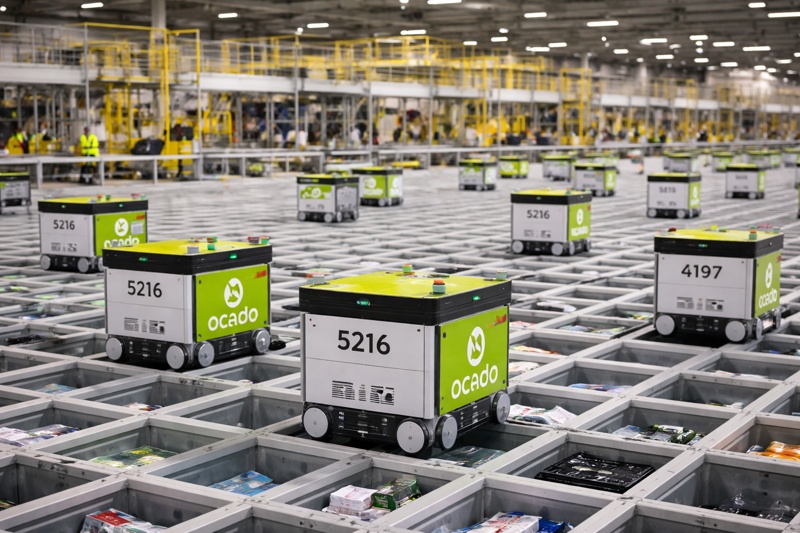
Ocado has spent more than a decade developing advanced automated fulfilment technology designed to support online grocery operations. At the heart of its platform are large scale customer fulfilment centres where fleets of small robots move across a grid system above stacks of grocery storage bins. The robots retrieve products stored within the grid and deliver them to picking stations where orders are assembled before dispatch to customers. The system combines robotics, automated storage and retrieval technology, machine learning and complex warehouse control software to coordinate thousands of simultaneous movements inside a distribution facility.
Over recent years the company has invested heavily in improving the performance of these systems. New generations of robots have been developed that can move faster, carry heavier loads and operate more efficiently within the grid structure. At the same time advances in artificial intelligence have improved the software that manages the flow of robots and goods through the warehouse. Machine learning algorithms are now used to analyse operational data from fulfilment centres and continuously optimise robot routing, traffic management and product storage locations. By analysing order patterns and movement data the system can determine where products should be positioned within the warehouse to minimise travel distances and reduce picking times.
These improvements have significantly increased the productivity of automated fulfilment centres. Warehouses equipped with the latest systems are able to process higher volumes of orders with greater efficiency and accuracy while reducing the amount of manual intervention required. According to Ocado, the increasing maturity of its technology means that fewer engineering resources are required to maintain and develop the platform compared with earlier stages of its development.
The restructuring reflects this shift in the company’s operations as its focus moves from building new technology towards expanding commercial deployments with retail partners around the world. Ocado’s automated fulfilment platform is now used by several major international grocery retailers, including Kroger in the United States, Casino in France, Sobeys in Canada and Coles in Australia. These retailers operate or are developing large automated distribution facilities designed to handle the growing demand for online grocery orders.
Within these facilities hundreds or sometimes thousands of robots operate continuously across the grid structure retrieving items stored within stacks of bins below the surface. The robots move in coordinated patterns controlled by centralised software which directs their movements to avoid congestion and maximise efficiency. The system is capable of assembling complex grocery orders containing dozens of different items while maintaining high levels of speed and accuracy. Automation also helps retailers maintain consistent service levels during peak periods such as holiday seasons or major promotional events.
As part of the restructuring programme Ocado is also combining its Ocado Solutions and Ocado Intelligent Automation divisions into a single structure. The move is intended to simplify the company’s operations and improve coordination between the teams responsible for developing and deploying its automation technology. Ocado Solutions focuses primarily on providing automated fulfilment technology to grocery retailers, while Ocado Intelligent Automation develops robotics systems that can be applied to other industries such as manufacturing and logistics. Bringing the two operations together may allow the company to accelerate the wider use of its robotics technology across different sectors while streamlining internal processes.
For the materials handling industry the announcement highlights a broader trend across warehouse operations as automation technology becomes more sophisticated and widely deployed. Highly automated distribution centres rely increasingly on robotics, automated storage systems and intelligent software to manage the movement of goods within warehouses. These technologies can significantly improve productivity, reduce manual handling and increase operational consistency across large logistics networks.
However the shift towards automation also changes the types of roles required within warehouse operations. Traditional manual handling tasks are gradually being replaced by robotic systems, while demand is growing for skilled workers capable of maintaining automated equipment, managing warehouse control systems and analysing operational data. Distribution centres equipped with advanced robotics typically require fewer warehouse operatives but more specialised technicians and engineers.
Despite the planned job reductions Ocado continues to expand its global automation platform and remains focused on deploying new automated fulfilment centres with retail partners. Demand for automated warehouse systems is expected to increase as retailers look for ways to improve efficiency, manage labour costs and support the growth of online shopping. Automation allows operators to handle higher order volumes while maintaining accuracy and reliability across complex distribution networks.
Developments at Ocado provide a clear example of how robotics and artificial intelligence are reshaping warehouse operations. As the technology continues to evolve, automated systems are likely to play an increasingly central role in the design and operation of modern distribution centres. For materials handling professionals the shift towards robotics driven logistics is expected to influence everything from warehouse layout and equipment selection to workforce skills and supply chain strategy.